
TECHNOLOGY
India AI Impact Summit 2026: Modi Pitches India as Global AI Hub

India AI Impact Summit 2026: Modi Pitches India as Global AI Hub
World leaders converge in New Delhi as India positions itself at the center of the global artificial intelligence revolution
🔑 Key Highlights
- PM Narendra Modi's Vision: "Design and develop in India. Deliver to the world. Deliver to humanity."
- Global Leaders Present: French President Emmanuel Macron, Google CEO Sundar Pichai, UN Secretary-General António Guterres
- Major Tech Investments: Microsoft ($17.5B), Google ($15B), Amazon ($35B by 2030)
- UN Proposal: $3 billion fund to help poorer countries build AI capacity
- Bill Gates Withdraws: Microsoft co-founder pulls out of keynote amid Epstein scrutiny
- Seven Core Themes: Human Capital, Inclusion, Safe AI, Resilience, Innovation, Democratizing Resources, Economic Growth
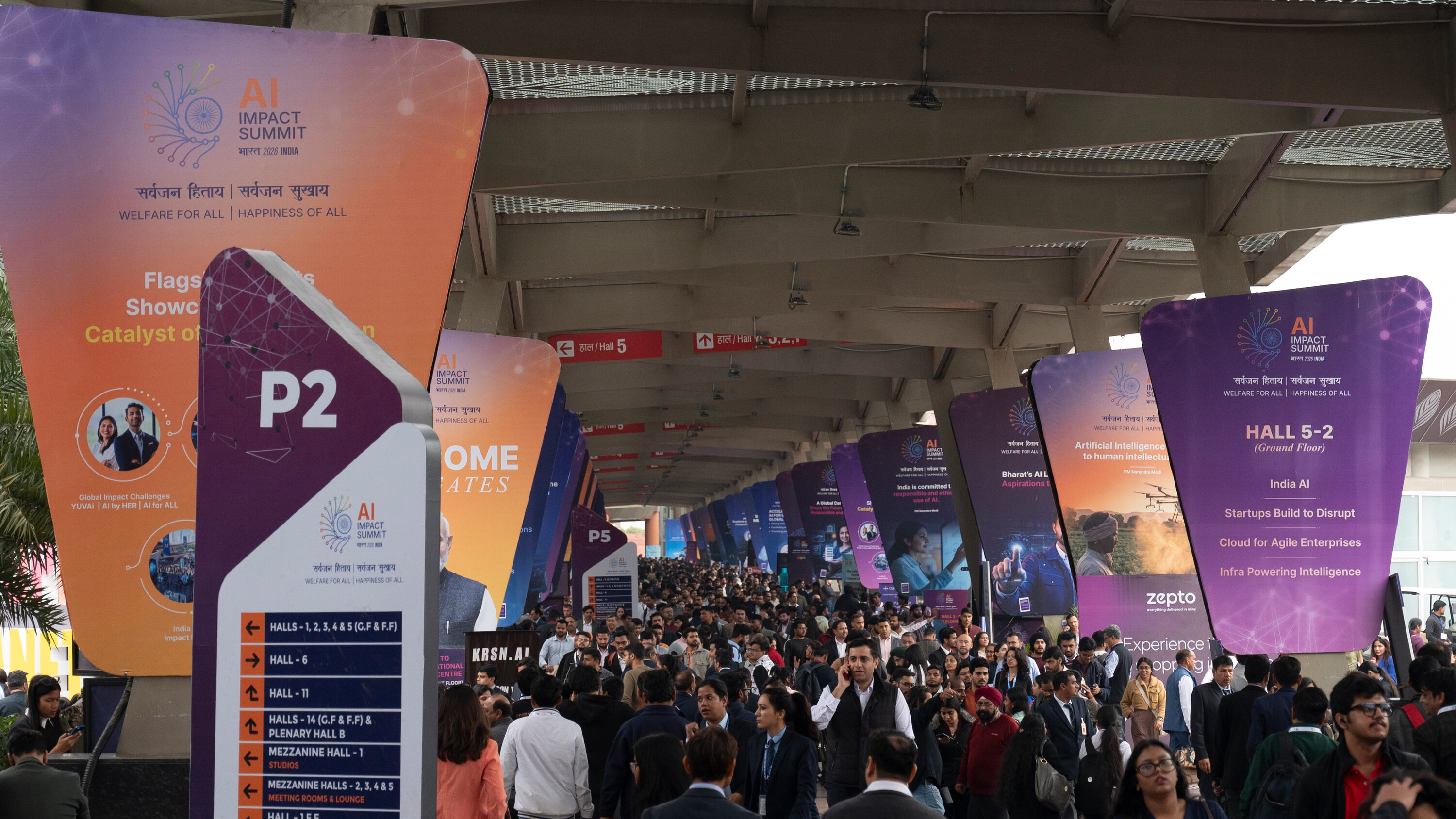
New Delhi, February 19: Indian Prime Minister Narendra Modi on Thursday delivered a powerful message to the world at the India AI Impact Summit, pitching India as a central player in the global artificial intelligence ecosystem. With nearly 1 billion internet users and a rapidly expanding digital infrastructure, India is positioning itself not just as a consumer of AI technology, but as a creator and exporter of AI solutions for the world.
"Design and develop in India. Deliver to the world. Deliver to humanity," Modi declared to a gathering of world leaders, technology executives, and policymakers at Bharat Mandapam. The summit, running from February 16-20, 2026, represents a strategic shift in global AI diplomacy—the first major international AI summit hosted in the Global South, aimed at bridging the divide between advanced economies and developing nations.
The MANAV Vision: AI for Humanity
Modi unveiled India's human-centric 'MANAV' vision for artificial intelligence, emphasizing that the technology must become "a shared resource for the benefit of all humanity." Drawing from India's cultural heritage, he referenced Lord Buddha's teaching that "right action comes from right understanding," stressing the importance of creating a roadmap that shows the true impact of AI on society.
"We must democratize AI. It must become a tool for inclusion and empowerment, particularly for the Global South," Modi stated. "We are entering an era where humans and intelligence systems co-create, co-work and co-evolve." The summit's framing around "impact" rather than just "action" signals India's intent to move beyond principles and pledges toward implementable cooperation and measurable public value.
🌍 The Seven Chakras of AI Impact
The summit is structured around seven core themes designed to shape a future-oriented agenda for impactful AI cooperation:
Global Leaders Converge in New Delhi
The summit attracted an unprecedented gathering of global dignitaries. French President Emmanuel Macron joined Modi in emphasizing the need for international cooperation on AI governance. Google CEO Sundar Pichai represented the tech industry's commitment to India's AI future, while UN Secretary-General António Guterres made a bold proposal for a $3 billion fund to help poorer countries build basic AI capacity, including skills, data access, and affordable computing power.
"The future of AI cannot be decided by a handful of countries, or left to the whims of a few billionaires. AI must belong to everyone."
— António Guterres, UN Secretary-General
OpenAI CEO Sam Altman also addressed the summit, calling for urgent AI regulation while warning against centralizing the technology in one company or country. "Democratisation of AI is the best way to ensure humanity flourishes," Altman stated, though he acknowledged that "centralising the tech in one company or country could lead to ruin." His appearance was notable for an awkward moment with Anthropic's CEO, highlighting the competitive tensions in the AI industry.
Tech Giants Bet Big on India
The summit coincided with massive investment announcements from global technology leaders. Microsoft announced a $17.5 billion investment over four years to expand cloud and AI infrastructure in India, following Google's $15 billion commitment over five years, including plans for its first AI hub in the country. Amazon has pledged $35 billion by 2030, targeting AI-driven digitization across sectors.
💰 Major AI Investments in India
$35B
Amazon (by 2030)
$17.5B
Microsoft (4 years)
$15B
Google (5 years)
India is also seeking up to $200 billion in data center investment in coming years
India is leveraging its experience in building large-scale digital public infrastructure—such as its digital ID and online payments systems—to present itself as a cost-effective hub for AI innovation, particularly for developing countries. However, the country still faces challenges in developing its own large-scale AI models, with limited access to advanced semiconductor chips and the complexity of training models on hundreds of local languages.
Controversies and Setbacks
Despite the high-profile gathering, the summit faced organizational challenges. Attendees and exhibitors reported long lines and delays on opening day, with some complaining on social media about stolen personal belongings and display items—though organizers later said the items were recovered.
⚠️ Summit Controversies
- Bill Gates Withdraws: Microsoft co-founder pulled out of scheduled keynote hours before the event. The Gates Foundation cited a desire "to ensure the focus remains on the AI Summit's key priorities," though the move comes amid renewed scrutiny over Gates's ties to Jeffrey Epstein.
- Fake Robot Scandal: A private Indian university was expelled from the summit after a staff member showcased a commercially available Chinese-made robotic dog while claiming it as the institution's own innovation.
- Organizational Issues: Long lines, delays, and theft complaints marred opening day proceedings.
Global Challenges and Youth Initiatives
In the lead-up to the summit, the Ministry of Electronics and Information Technology (MeitY) launched several flagship programs and global challenges. The AI for ALL Global Impact Challenge invites innovators worldwide to showcase AI solutions across sectors. AI by HER focuses on scaling women-led AI innovations, while YUVAi targets youth aged 13-21 to demonstrate AI-enabled problem-solving for social good. Awards of up to INR 6 Crores are available for winners, along with global showcase opportunities and mentorship.
The Road Ahead: Sovereign AI and Global Governance
A central theme emerging from the summit is the tension between AI sovereignty and global interoperability. India has argued that the concentration of AI capabilities in a few countries and firms poses significant risks, motivating investments in domestic sovereign AI models. Brookings Institution experts note that India and other countries frame this as both a development issue and a resilience concern—when advanced AI is concentrated, most nations become technology dependent rather than rule-makers.
"When AI systems are built for a narrow set of contexts, they may not transfer well globally," noted Elham Tabassi of Brookings. "In a country like India with many dialects, this becomes a question of access and usability." The summit aims to address broader access to compute, inclusive standard-setting, and capacity-building mechanisms for the Global South.
🎯 Pre-Summit Global Engagement
The road to the India AI Impact Summit included recognized events across four continents:
- Oslo, Norway: Side event at 2025 Internet Governance Forum
- Buenos Aires, Argentina: Multi-day workshop at Universidad de Palermo
- Cape Town, South Africa: Global DPI Summit consultative workshop
- New Delhi, India: Operationalising AI Safety focus event
- Barcelona, Spain: Mozfest unconference session
- Geneva, Switzerland: Collaborative Pathways for AI Governance workshop
Conclusion: A Pivotal Moment for Global AI
The India AI Impact Summit 2025 represents a pivotal shift in the global AI conversation—from Western-centric development to inclusive, Global South-led innovation. With massive tech investments, ambitious government initiatives, and a focus on democratizing AI for humanity, India is positioning itself as the bridge between advanced AI capabilities and the developing world's needs.
As Modi declared, "We must resolve that AI is used for the global common good." Whether this summit delivers on its promise of measurable impact remains to be seen, but it has undeniably established India as a major player in shaping the future of artificial intelligence governance, development, and deployment.