
TECHNOLOGY
Saram AI Revolutionizes India’s Exciting Multilingual Future
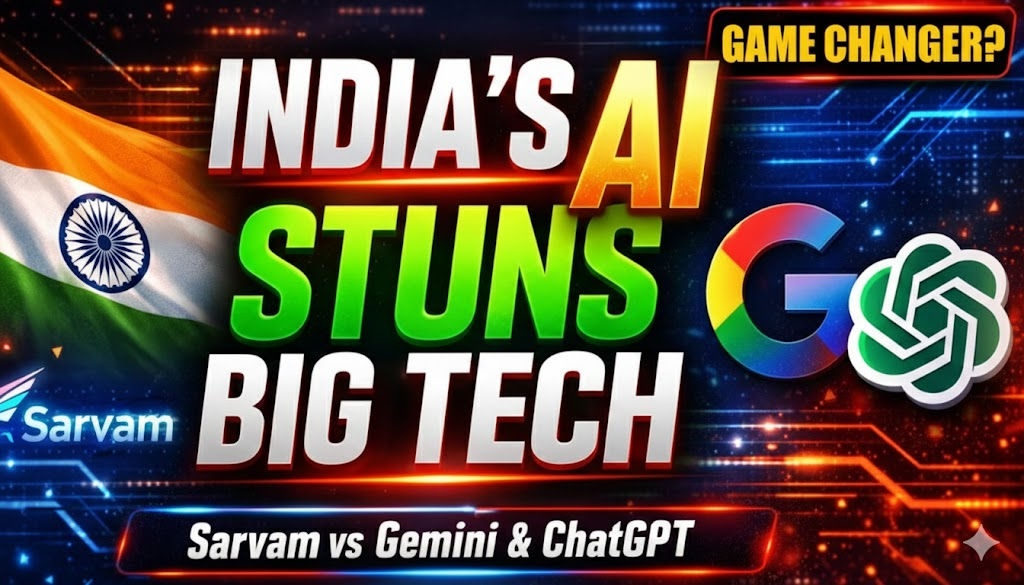
India’s Home‑grown AI Push: How Saram AI Is Building “Sovereign” Intelligence for a Multilingual Nation
For years India has been a voracious consumer of foreign artificial‑intelligence platforms—ChatGPT, Google Gemini, Anthropic’s Claude, and the like. While those tools have accelerated digital transformation, they often stumble over two uniquely Indian challenges: the country’s staggering linguistic diversity and the sheer volume of paper‑based records that still dominate government and corporate archives.
A Bengaluru‑based startup, Saram AI (sometimes rendered as “Survi” or “Servam” in early coverage), is attempting to change that narrative. By developing AI models specifically tuned to Indian languages and document types, the company aims to give the nation its own “sovereign AI” stack—technology that can be owned, controlled, and continuously improved within India’s borders.
The following article unpacks Saram AI’s two flagship products, the market need they address, and how they fit into the broader Indian AI strategy.
The Two Pillars of Saram AI’s Offering
| Product | Core Function | Why It Matters for India |
|---|---|---|
| Saram Vision | OCR (Optical Character Recognition) and document understanding | Enables AI to read scanned pages, handwritten forms, and messy government paperwork—critical for digitising India’s massive paper archives. |
| Bulbul | Text‑to‑speech (TTS) engine supporting Indian languages | Gives AI a natural voice in 35+ voices across 11 languages (with plans for 22), opening up voice‑first services for a multilingual population. |
1. Saram Vision – Reading the Paper‑Heavy Landscape
India’s public sector still relies heavily on physical records. From land‑registry deeds to tax filings, countless documents exist only as paper. Traditional OCR solutions, often trained on Latin‑script data, deliver sub‑par accuracy on Indian scripts and on low‑quality scans.
Saram Vision tackles this head‑on:
- Benchmark Performance: In an internal OCR benchmark, the model achieved 84.3 % accuracy, out‑performing Google Gemini on the same test set. While not a universal AI metric, this demonstrates concrete superiority in a task that directly impacts Indian workflows.
- Domain‑Specific Training: The model was fine‑tuned on a corpus of Indian government forms, handwritten notes, and regional scripts, allowing it to handle the “messy” documents that generic models struggle with.
The practical upshot? Faster digitisation of archives, reduced manual data entry costs, and a foundation for downstream AI applications such as automated compliance checks or searchable knowledge bases.
2. Bulbul – Giving AI a Local Voice
Voice assistants and automated call‑centres have exploded worldwide, but most commercial TTS engines excel only in English and a handful of other major languages. In India, where 22 officially recognised languages and hundreds of dialects coexist, a monolingual voice solution excludes a large swath of users.
Bulbul’s strengths:
- Multilingual Coverage: Currently supports 35 distinct voices across 11 Indian languages (including Hindi, Tamil, Telugu, Bengali, Marathi, and Malayalam). The roadmap targets 22 languages, covering the majority of the country’s linguistic landscape.
- Naturalness & Expressiveness: The TTS engine employs a neural vocoder trained on native speakers, delivering a natural cadence that feels less robotic—crucial for customer‑service applications, educational content, and accessibility tools for the visually impaired.
By localising speech output, Bulbul can power everything from government helplines to regional e‑learning platforms, dramatically widening AI’s reach.
How Saram AI Fits Into India’s “Sovereign AI” Vision
The Indian government has earmarked tens of thousands of crore rupees for a sovereign AI programme, aiming to reduce dependence on foreign models, protect data privacy, and foster home‑grown talent. Saram AI’s tools exemplify this policy thrust in three ways:
- Data Residency & Security – The models are trained on Indian datasets stored on domestic cloud infrastructure, ensuring that sensitive citizen data does not cross borders.
- Economic Retention – By keeping the AI development loop within India, the country retains token‑level value that would otherwise flow to overseas providers.
- Cultural Relevance – Tailoring AI to local scripts, idioms, and pronunciation bridges the digital divide, especially for rural and semi‑urban populations.
Union Minister Ashwini Vaishnav recently praised early successes of sovereign AI pilots, citing Saram AI as a “proof‑of‑concept that Indian ingenuity can match global benchmarks in niche, high‑impact domains.”
Competitive Landscape
Saram AI is not alone in the race to build Indian‑centric AI:
| Company | Focus Area | Notable Progress |
|---|---|---|
| Hugging Face India Labs | Open‑source language models | Released multilingual BERT variants trained on Indian corpora. |
| Nami.ai | Healthcare AI | Deployed diagnostic assistants for regional hospitals. |
| Sigthupal | FinTech AI | Built fraud‑detection engines tuned to Indian transaction patterns. |
What distinguishes Saram AI is its dual emphasis on document intelligence and speech synthesis, two verticals that directly address the country’s bureaucratic and linguistic bottlenecks.
Potential Challenges
While the early results are promising, several hurdles remain:
- Scalability of Training Data: Gathering high‑quality, annotated datasets for every Indian language is resource‑intensive.
- Regulatory Hurdles: Government procurement processes can be slow, potentially delaying large‑scale adoption of Saram Vision in ministries.
- Competition from Global Players: Giants like Google and Microsoft are rapidly expanding their multilingual capabilities, which could erode Saram AI’s niche advantage if they invest heavily in Indian language support.
Addressing these challenges will require continued public‑private collaboration, sustained funding, and a focus on open standards that allow interoperability with other Indian AI initiatives.